



UO Space • September 11, 2026
Luxury Hospitality Is Getting More Standardized.Independent Owners Should Pay Attention.
UO Point of View | Strategic Transformation Business & Corporate Strategy × Market & Competitive Intelligence

The luxury hotel market is getting crowded.
Not necessarily with more hotels. With more versions of luxury.
Global operators are expanding their luxury portfolios. Collection brands are bringing independently positioned hotels into global distribution and loyalty ecosystems. Regional hospitality groups are building multi-property platforms around their own ideas of place and service. And developers are increasingly repositioning existing assets rather than treating every new project as a completely new proposition.
CBRE's 2025 research shows just how quickly the market is changing: independent hotels represented 33% of existing hotel supply in Asia Pacific, but only 4% of the region's development pipeline. Meanwhile, hotels aligned with the eight largest listed global hotel companies represented 18% of existing supply but 74% of the pipeline. Those same eight operators increased their number of brands in Asia Pacific from 58 in 2014 to 130 in 2024.
That is a remarkable change in the competitive landscape.
But the more interesting question is why.
The major hotel companies are not simply putting more flags into the market. They are getting better at offering different versions of the same underlying platform: luxury, lifestyle, wellness, design-led, destination-led, independent-looking, branded, soft-branded and everything in between.
If the big platforms can scale individuality, what exactly makes your hotel difficult to replace?
The industry has learned how to scale individuality
For a long time, the trade-off seemed straightforward. A global hotel brand gave an owner scale: distribution, loyalty, sales, systems and recognition. An independent hotel gave the owner something harder to manufacture: character. That distinction is becoming less reliable.
Take Marriott's The Luxury Collection. It does not ask every property to look like the same hotel. Instead, it brings destination-specific properties into a global luxury platform. In Indonesia, that includes properties such as TA'AKTANA in Labuan Bajo, where the proposition is built around Flores, the sea and the culture of the region rather than simply applying a generic luxury template. Autograph Collection and Hyatt's Unbound Collection follow a similar logic: individually positioned properties connected to a much larger commercial ecosystem.
The strategy is clever because the guest can still buy difference while the owner can access scale. The things independent hotels once held almost exclusively—story, place, personality and individuality—can now travel through sophisticated global platforms.
Individuality is no longer necessarily the opposite of scale.
So what does “independent” actually mean anymore?
Consider Aman.
Amankila in Bali does not look like Aman Tokyo.
Amanjiwo in Central Java does not feel like Aman New York.
That is precisely the point.
Aman describes its approach as one in which architecture, geography, culture and heritage shape each property. Yet that highly specific philosophy now operates across a global platform of 36 hotels, resorts and residence developments in 21 countries.
So is Aman independent? That is almost the wrong question.
The more interesting question is:
How did Aman make a highly specific idea of luxury scalable without making every property the same?
The real threat is not brands. It is commoditized differentiation.
Luxury hospitality has become very good at speaking the language of differentiation.
Local. Authentic. Personalized. Wellness. Sense of place. Immersive.
Almost every luxury property can now say some version of these things. That doesn't make them meaningless. It makes them insufficient.
The question is no longer whether a hotel has a local story. It is whether that story actually changes the customer's decision—whether it creates preference, supports the rate, drives repeat demand or shapes the experience itself.
If it doesn't, it may be differentiation in the marketing copy, but not in the business.
And that is where the real problem lies. The market is getting very good at reproducing the visible language of luxury. What is much harder to reproduce is the system underneath it: the relationships, culture, experience, commercial model and organizational capability that make the promise real.
Indonesia Is Already Experimenting With the Answer
Indonesia is particularly interesting because some of its strongest hospitality businesses have not treated local identity as something to preserve by remaining small. They have used it as a source of differentiation, a platform for growth, or even the business model itself.
NIHI Sumba — When the destination is the product
 Source: nihi.com
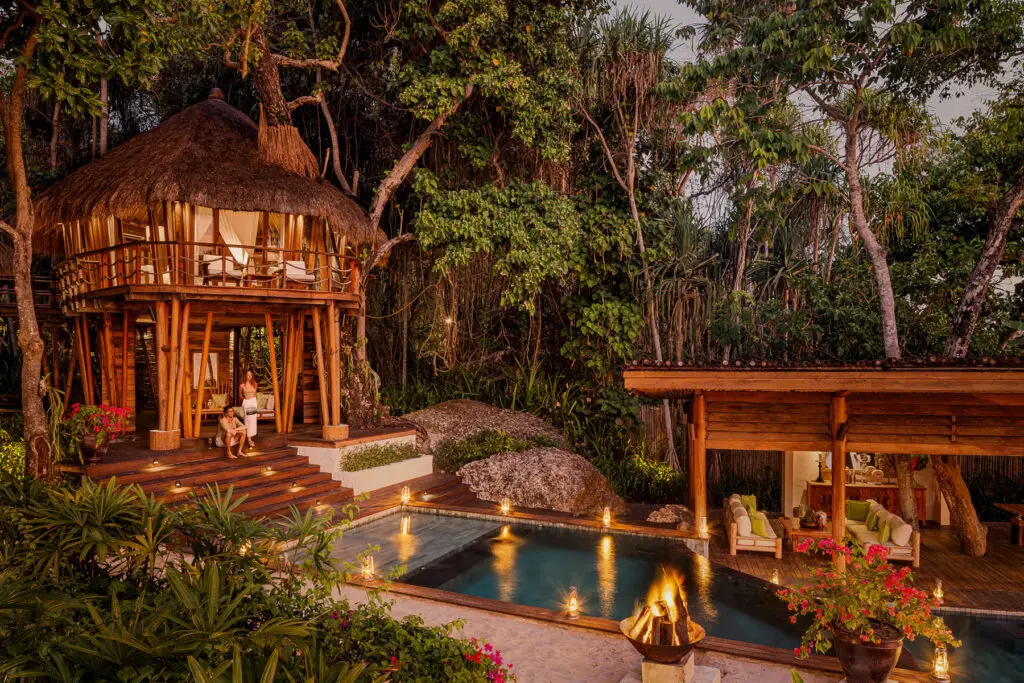
NIHI Sumba is difficult to separate from Sumba itself. Its 31 villas, 2.5 kilometres of beach and 270 hectares of surrounding nature are supported by experiences built around the island's landscape, culture and community, with 93% of its staff local. (NIHI factsheet)
The lesson isn't simply that authenticity matters. It is that the harder a proposition is to separate from its place, the harder it is to commoditize.
AYANA — When scale happens around the destination

Souce: booking.com
AYANA offers another model. At its Bali destination, multiple hotel propositions sit within a much larger ecosystem of dining, wellness, leisure and experiences. The individual properties do not need to be identical for the destination to benefit from shared infrastructure and cross-property demand.
The scale sits underneath the guest proposition, rather than replacing it.
Plataran — When identity becomes a platform

Source: plataran.com
Plataran has taken a different route. Rather than building its identity around one property, it has built a portfolio around Indonesia's natural and cultural assets, anchored by Nature, Culture and Community. Its 2026 HOPE — Home of Peaceful Escapes proposition connects destinations including Borobudur, Bromo, Puncak, Menjangan, Ubud and Komodo through a wellness-led journey.
Plataran is turning a collection of places into a connected customer proposition.
The identity travels, even when the property changes.
Tentrem — When a brand travels without copying the property
 Source: www.hoteltentrem.com
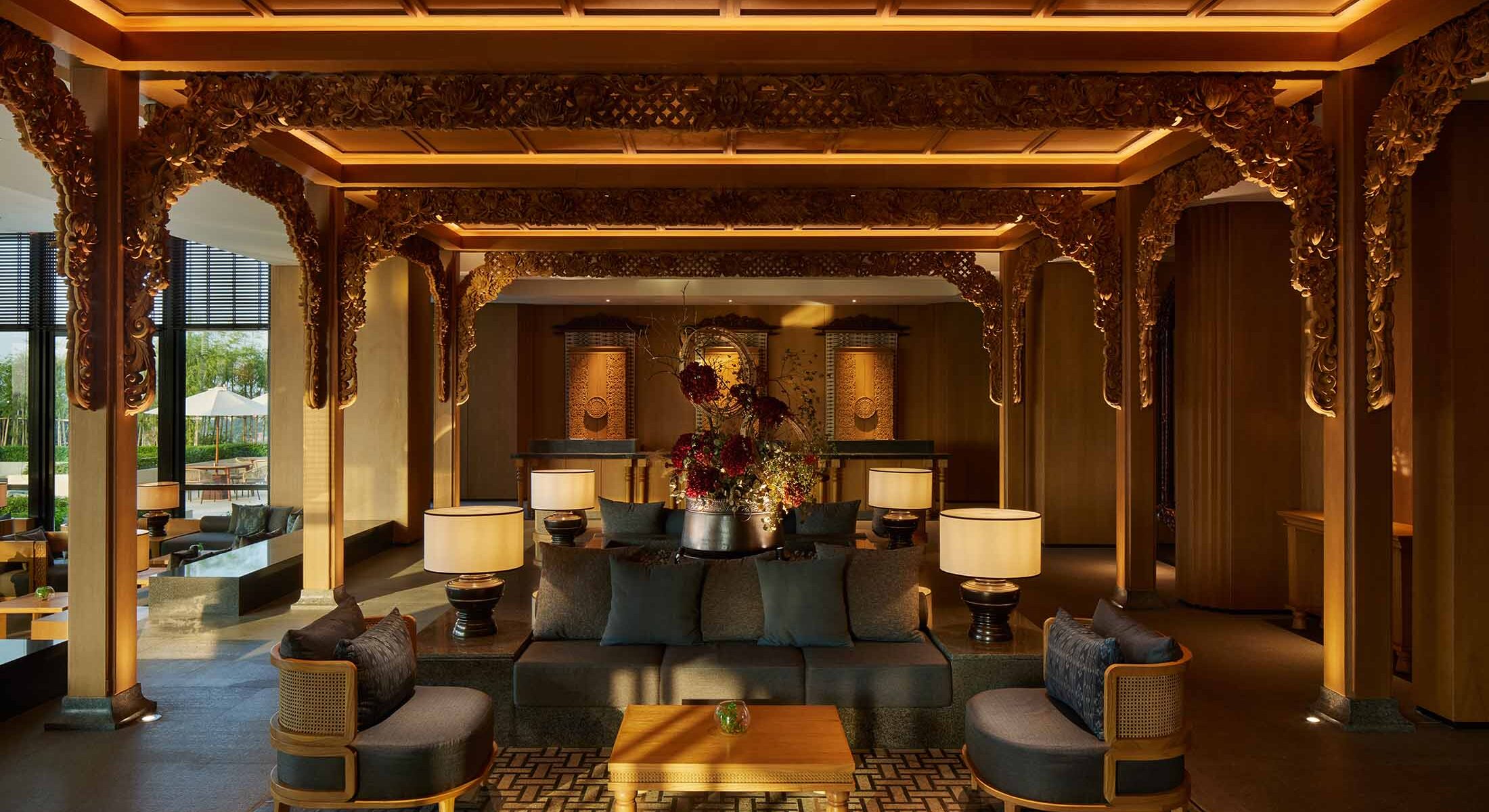
Hotel Tentrem offers another model. Its properties in Yogyakarta, Semarang and Jakarta are not simply replicas of one another. Each interprets its location differently, while maintaining a recognisable Tentrem proposition.
A scalable brand does not necessarily need a standardized property.
The brand can provide the common thread; the destination provides the variation.
Bawah Reserve — When the place is the business model
 Source: images.trvl-media.com
Bawah Reserve takes the idea even further. Across six private islands in Indonesia's Anambas Archipelago, the proposition combines accommodation with conservation, nature, wellbeing, dining and access.
The differentiation isn't one feature that can be copied. The proposition is the ecosystem.
And that matters because copying a hotel is relatively easy. Recreating the place, the access, the conservation model, the operating environment and the experience around it is considerably harder.

What are you actually protecting?
For an independent owner, the decision is often framed as a choice between staying independent and taking a brand.
That is too narrow.
The more useful question is:
What makes this business valuable in the first place—and which parts of it would be weakened if they were standardized?
Because not everything worth protecting is visible.
It may be the relationship with a particular community. The credibility of a founder. A deeply local service culture. A wellness philosophy that runs through the guest journey rather than sitting in the spa. A destination that cannot be replicated. A culinary reputation. Or a combination of several things that, together, gives the property its pricing power.
And then there is the uncomfortable part:
Are we protecting the advantage, or simply protecting the way we have always done things?
An owner can be fiercely protective of its name, its design, its rituals or its operating habits—and still lose the things customers actually value.
There is another layer to this. A proposition is only as strong as the organization capable of delivering it. A hotel can market discretion, personalization and a deep connection to place, but if those ideas exist only in the founder's head—or only in the brand book—they are not yet a defensible competitive advantage.
As an independent business grows, that becomes increasingly important. The challenge is not to preserve everything exactly as it was. It is to make sure the organization can carry the original idea without the original owner having to carry the entire business.
What must remain distinctive, what must become more capable, and what can change without changing the reason guests choose us?
Where should an owner draw the line?
The strategic question is not simply what an independent owner wants to control. It is what the business must protect, strengthen or change to remain valuable as it grows.
Not everything worth protecting is visible. And not everything that is visible is actually an advantage.
| If the owner is trying to preserve… | The strategic question is… |
| A highly specific local identity | Can we make that identity commercially stronger as we grow—or are we simply protecting it from change? |
| Control over the guest proposition | Which parts of the experience genuinely create preference—and which are simply industry convention? |
| Pricing power | What makes guests willing to pay more here than elsewhere—and can the business consistently deliver enough value to support that premium? |
| Direct customer relationships | Do we actually understand our customers—or do the intermediaries distributing us know more about them than we do? |
| A distinctive business model | Which capabilities are truly strategic to the model—and which can be accessed more effectively from outside? |
| A strong service culture | Does the organization actually live the values the brand promises to guests? |
| Owner-led decision making | Can the organization preserve the owner's intent without requiring the owner in every decision? |
| The freedom to evolve | Do we have the commercial and organizational capability to use that freedom—or has independence itself become a constraint? |
The last question is perhaps the most uncomfortable. Luxury hospitality often sells sophistication, discretion, care and personalization. But those ideas cannot live only in the brand book, the architecture or the guest-facing experience. If the organization delivering the promise does not believe in it, the promise eventually breaks.
A brand cannot sustainably sell a version of luxury that its own organization does not believe in.
That is why organizational capability belongs in this conversation. The goal is not to preserve every founder habit, ritual or way of working. It is to build an organization capable of carrying the original idea forward—without diluting it and without requiring the owner to carry the entire business.
Ultimately, the line should not be drawn between “ours” and “theirs.” It should be drawn between what creates value and what merely supports it.
Don't outsource your advantage. Don't build infrastructure for the sake of independence.
The question, then, is not whether scale is good or bad. It is what happens to the proposition when the business grows.
Scale Is Not the Enemy. Undifferentiated Scale Is.
Scale used to imply standardization. Increasingly, it does not.
The more important question is what scale does to the proposition. Does growth make the business more capable of delivering what makes it valuable? Or does it slowly replace the original idea with processes, channels and conventions that could belong to almost anyone?
That distinction is becoming more important as capital moves deeper into luxury hospitality. JLL reports that luxury hotel transaction volumes across Asia Pacific reached approximately US$2.1 billion in 2025, up 77% from 2017, while luxury hotels represented almost 20% of regional hotel transactions, more than double their 2017 share. JLL also notes that operators are increasingly using differentiated concepts—from wellness-focused retreats to culturally immersive experiences—to target specific guest preferences.
For owners, the implication is not simply that there will be more competition. It is that the competition will become better at combining distinctiveness with capability.
A beautiful property can be copied. A local story can be marketed by someone else. A wellness concept can be packaged, branded and distributed at scale. What becomes harder to reproduce is the combination of a proposition people value, an organization that can consistently deliver it, and a commercial model that captures the value it creates.
That is the new strategic battleground.
Not independent versus branded.
Not small versus large.
Distinctive versus replaceable.
© 2023 UO. All Rights Reserved.